








What if your family tree held the key to living, working, and retiring anywhere across 27 different European countries? Obtaining irish citizenship is more than just getting a new passport; it’s a life-changing gateway to the EU. We know that the 18 month average processing times and the complex math of “reckonable residence” can feel like a brick wall. Like many of the 1,000 plus expats we’ve helped, you might be tired of digging through archives for a single 1920s birth certificate or worrying that a minor paperwork error will reset your entire journey. It’s frustrating to feel stuck when your dream of a new life is so close.
We’re here to help you clear the fog and find the right path forward. This guide provides a complete roadmap for your 2026 application, showing you exactly how to navigate the latest Department of Justice requirements. You’ll discover the fastest routes through heritage, marriage, and residency. We’ll break down the specific documents you need and how to handle the bureaucratic hurdles. By the time you finish reading, you’ll have the confidence to gather your records and take that first exciting step toward your Irish passport.
Key Takeaways
- Discover why an Irish passport is considered a 2026 “golden ticket,” offering unique, dual access to live and work across both the EU and the UK.
- Learn how to claim irish citizenship through your family tree using the Foreign Births Register, even if you were born abroad.
- Master the “5 out of 9 years” residency rule and the essential Scorecard System used to verify your identity and history in Ireland.
- Explore faster 3-year routes to citizenship through marriage or civil partnerships, plus discretionary paths for those with strong Irish associations.
- Get a step-by-step roadmap for the 2026 application process, from certifying your foreign documents to the final citizenship ceremony.
Why Irish Citizenship is the Ultimate “Golden Ticket” in 2026
Imagine holding a single document that unlocks the doors to 27 European Union countries and the United Kingdom simultaneously. This isn’t a hypothetical dream; it’s the reality of holding irish citizenship. As we look toward 2026, the Irish passport has solidified its status as one of the most practical and prestigious assets for global citizens. Ireland occupies a unique legal position due to the Common Travel Area (CTA) agreement. This arrangement allows Irish citizens to live, work, and study in the UK without needing a visa, even after Brexit. It’s the only nationality in the world that offers this “best of both worlds” access to two major economic zones.
The legal framework governing these rights is found in Irish nationality law, which has evolved to be remarkably inclusive. Whether you’re looking for a plan B or a permanent move, the security provided by the Irish state is unparalleled. In 2026, the freedom to pivot between the tech hubs of Dublin and the financial centers of London is a competitive advantage that few other citizenships can match. We’ve helped many families realize that this isn’t just about travel; it’s about securing a legacy of opportunity for future generations.
The accessibility of this status is what truly sets it apart. With an estimated 70 million people worldwide claiming Irish heritage, the “Irish Diaspora” makes this one of the most reachable citizenships on the planet. If you have a drop of Irish blood or have spent time living on the Emerald Isle, you might already be closer to your “Golden Ticket” than you think. Let’s look at why this passport is consistently ranked in the top five globally and how you can claim yours.
The Power of the Irish Passport
By 2026, the Irish passport remains a powerhouse of mobility. It currently provides visa-free or visa-on-arrival access to over 190 destinations. Beyond travel, it grants you the right to reside in any EU member state, from the beaches of Spain to the mountains of Austria, with zero bureaucratic hurdles. You don’t have to worry about losing your original identity either. Ireland fully embraces dual citizenship. You can keep your current passport while adding the benefits of an Irish one, ensuring you stay connected to your roots while expanding your horizons.
For many of our clients, the decision is as much about the heart as it is about the head. Reclaiming your Irish heritage is a powerful emotional journey. It’s about more than just a document; it’s about reconnecting with the stories of your ancestors who may have left Cork or Galway decades ago. Holding that passport feels like a homecoming, even if you’ve never set foot in Dublin Airport. It’s a tangible link to a culture known globally for its warmth, resilience, and “ceol agus craic” (music and fun).
Which Route is Right for You?
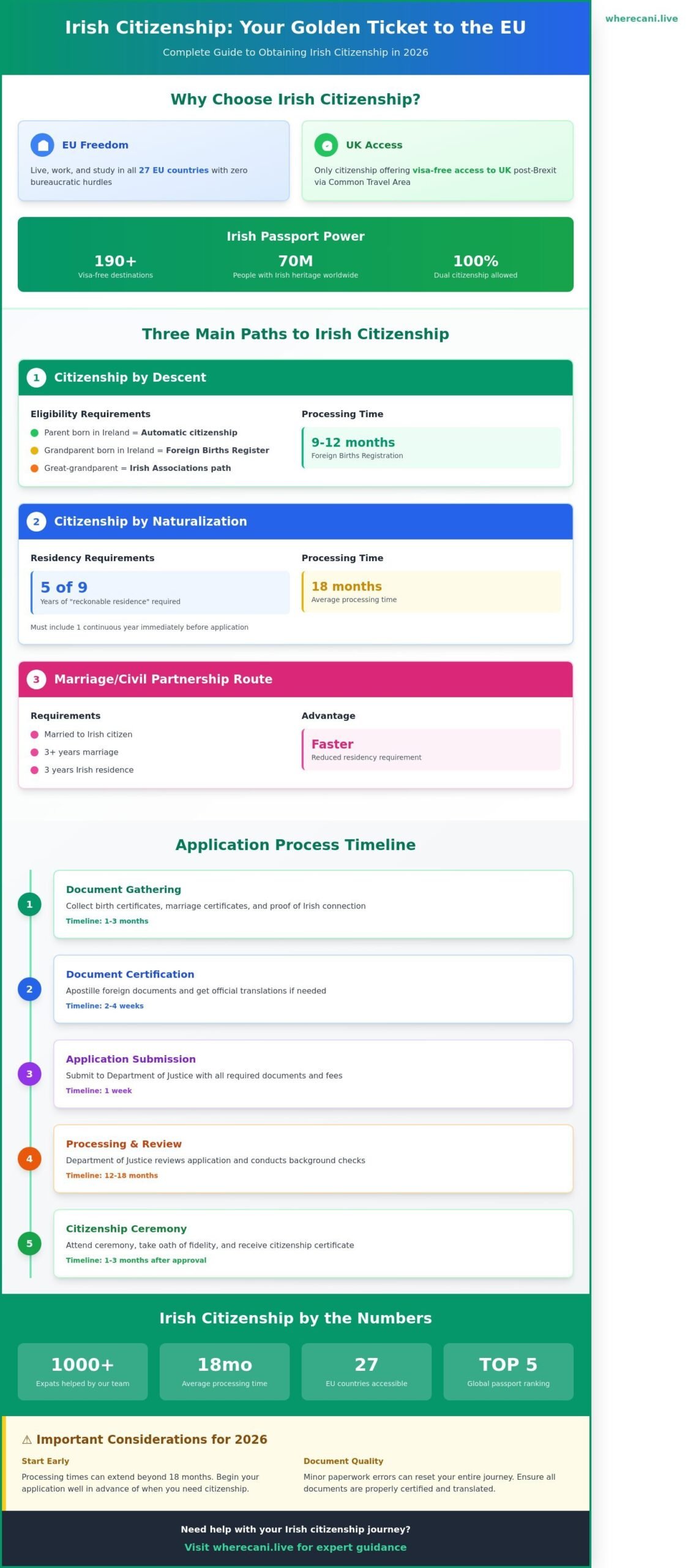
Are you wondering if you qualify? Most people find their way through one of three primary paths. If you have a parent born on the island of Ireland, you’re likely already a citizen and just need to apply for your passport. If it’s a grandparent, you’ll need to join the Foreign Births Register first. This process can take 9 to 12 months, so starting early is essential for your 2026 goals. We recommend checking your family tree for these specific links:
- Parent born in Ireland: Automatic citizenship in most cases.
- Grandparent born in Ireland: Citizenship via Foreign Births Registration.
- Great-grandparent born in Ireland: Possible through “Irish Associations” if you can prove a strong ongoing link to the community.
If you don’t have the lucky “bloodline” connection, naturalization is your best bet. If you’ve been living in Dublin, Cork, or any part of the Republic for 5 out of the last 9 years, you may be eligible to apply. This timeline is even shorter if you are married to an Irish citizen; in that case, the residency requirement drops to just 3 years. The Irish government has streamlined many of these digital applications, making the dream of irish citizenship more attainable than ever before for dedicated expats.
Get Expert Irish Immigration Advice
Irish immigration law is complex, but you don’t have to face it alone. Stephen and his team have guided hundreds of our clients through every step of the process, from first application to final approval.
Citizenship by Descent: The Foreign Births Register (FBR)
If you have an Irish grandparent, a world of opportunity just opened up. You don’t need to live in Ireland for years to get a passport. Instead, you can claim your irish citizenship through a process called Foreign Births Registration. This is a legal record maintained by the Department of Foreign Affairs. Once your name is on this register, you’re considered an Irish citizen from that date forward. It’s a life-changing step that grants you the right to live, work, and travel freely across the European Union.
The FBR is the gatekeeper for those born outside Ireland. While many people pursue Irish citizenship by naturalisation after years of residency, the descent route is often faster and more direct. However, it isn’t automatic. You must apply, provide a mountain of evidence, and wait for approval. In early 2026, the Department of Foreign Affairs reported that average processing times have stabilized at approximately 10 to 12 months. This is a significant improvement from the 18-month backlogs seen in previous years, but you still need patience.
Your parent’s status is the most critical factor in this chain. If your parent was an Irish citizen at the time of your birth, you might already be a citizen without realizing it. If they became a citizen through the FBR before you were born, you’re eligible too. But if they registered after your birth, the chain unfortunately breaks for you. It’s a strict rule that catches many families off guard.
Are You Eligible Through a Grandparent?
The “Grandparent Rule” applies if at least one of your grandparents was born on the island of Ireland. This phrase is vital because it includes all 32 counties. It doesn’t matter if your grandmother was born in Cork or Belfast; both qualify you for irish citizenship. Because Northern Ireland is part of the “island,” those with ancestors from the North have the same rights to an Irish passport as those from the Republic.
If you’re looking at a great-grandparent, the rules change. You can only claim citizenship through them if your own parent was already registered on the FBR at the time of your birth. Most people find that the grandparent connection is the most common path. If you aren’t sure where to start, you can talk to our immigration expert to verify your specific family tree before you spend money on application fees.
The Essential Document Trail
The Irish government requires an unbroken paper trail of “long-form” certificates. These must show the names of the parents to prove the biological link. You’ll need the following for yourself, your parent, and your Irish-born grandparent:
- Civil birth certificates (showing parents’ names)
- Civil marriage certificates (if names changed)
- Certified copies of current passports
- Proof of address (utility bills or bank statements)
- Death certificates for deceased ancestors
Finding “lost” records is often the hardest part. If your ancestors left Ireland decades ago, start with the General Register Office (GRO) in Roscommon or the National Archives in Dublin. For records from the United States, United Kingdom, or Australia, ensure you order “vault” or “exemplified” copies. Standard short-form certificates usually lack the parental details the FBR office demands. If a document isn’t in English, you’ll need a certified translation. Double-check every date and spelling; a single typo can lead to a rejection and another year of waiting.

Citizenship by Naturalization: The Residency Path
Naturalization is the most common route for expats to secure irish citizenship. It’s a process based on your physical presence and your commitment to making Ireland your permanent home. The foundation of this path is the “5 out of 9 years” rule. You must prove you’ve lived in Ireland for a total of five years (1,825 days) out of the previous nine years. This calculation isn’t just about the dates you arrived; it’s about “reckonable residence,” which refers to the specific time spent under qualifying immigration stamps. If your family tree has Irish roots, you should first check if you qualify for Citizenship by descent, as this can be a much faster route than naturalization.
The final year of your application is the most critical. You must show “continuous residence” for the full 365 days immediately preceding the date you apply. While the Department of Justice previously allowed for very little flexibility, current policy generally permits up to 70 days of absence for work or holidays during this final year. If you exceed this limit, your “continuous” clock might reset. It’s a strict rule, so keeping a detailed log of every flight and ferry trip is essential for a smooth approval.
British, EU, EEA, and Swiss nationals follow slightly different rules. Because these citizens don’t receive immigration stamps in their passports, they don’t track reckonable residence through the typical Stamp 1 or Stamp 4 system. Instead, they must prove they were “exercising EU treaty rights.” This means providing evidence of employment, self-employment, or self-sufficiency for the required five-year period. It’s often a more document-heavy process because there is no central immigration database tracking every entry and exit for EU citizens.
Calculating Your Reckonable Residence
Not all time spent in Ireland counts toward your 1,825-day total. Time spent on a Stamp 2 student visa or while seeking international protection is excluded. You should focus on Stamp 1 (employment), Stamp 1G (graduate), or Stamp 4 (general residency) periods. Use the official online residency checker tool to tally your days precisely. Even a small miscalculation can lead to a summary rejection, so double-check every date against your passport stamps and IRP cards.
The 2026 Scorecard: Proving You Live Here
To prevent fraud, Ireland uses a strict scorecard system for identity and residency. You must reach 150 points for every year of residence you claim. A P60 or Employment Detail Summary provides 70 points, while a utility bill or bank statement showing Irish transactions adds 20 to 50 points. A common pitfall is providing documents that aren’t on the approved list, such as mobile phone bills, which carry zero weight. Missing the 150-point threshold by even a single point will result in your application being returned.
Applying for irish citizenship is a marathon, not a sprint. By staying organized with your paperwork and monitoring your travel days, you can turn this complex legal requirement into a straightforward administrative task. We’ve seen hundreds of expats successfully navigate this, and the reward of an Irish passport makes the meticulous record-keeping well worth the effort.
Alternative Routes: Marriage, Civil Partnership, and Associations
If you don’t have a parent or grandparent born on the island, you might feel like the door to irish citizenship is closed. It’s not. Ireland provides several alternative paths for those who have built a life or a deep connection here. Whether you’ve fallen in love with an Irish local or you can trace your heritage back to a great-grandparent, these routes offer a way to secure your future in Europe. We’ve helped many people realize that their family tree or their marriage certificate is the key to a new life abroad.
Marriage and Civil Partnerships
Marrying an Irish citizen doesn’t grant you a passport automatically on your wedding day. You’ll need to meet the three-year residency requirement first. To qualify, you must be married or in a civil partnership for at least 36 months and be living together as a couple. The state requires 1,095 days of “reckonable residence” on the island of Ireland before you can apply. It’s vital that your marriage is legally recognized under the Civil Registration Act 2004. You’ll need to provide joint bank statements, utility bills, and tenancy agreements to prove your relationship is genuine and that you share a household.
The “Irish Associations” Loophole
This route is a unique, discretionary path for those with “Irish associations.” This usually refers to people who have an Irish great-grandparent or other close relatives who were citizens. Unlike the Foreign Births Register, which is a legal right for grandchildren, this path is entirely at the discretion of the Minister for Justice. You’ll need to prove a sustained link to the community or show how your irish citizenship would benefit the state. Because there’s no set formula for success, these applications require meticulous documentation and a compelling personal narrative. If you’re looking into this complex route, we recommend booking an immigration consultation with Stephen and his team, to ensure your evidence is as strong as possible.
Beyond ancestry and marriage, Ireland provides clear pathways for families and those seeking safety. If you’re a naturalized citizen, your children don’t have to wait until they’re adults to join you in citizenship. You can apply on behalf of your minor children using Form 11 once you’ve been granted your own certificate of naturalization. This ensures the whole family can move forward with the same legal protections and rights.
For those who arrived in Ireland seeking international protection, the timeline to citizenship is accelerated. While standard naturalization typically requires five years of residency, recognized refugees can often apply after just three years. This period is calculated from the date you first arrived in the state to seek asylum. It’s a vital part of Ireland’s commitment to humanitarian support, helping people build a permanent, secure life after displacement.
- 3 years: The residency requirement for spouses of Irish citizens.
- Form 11: The specific application form used for minor children of naturalized parents.
- Ministerial Discretion: The deciding factor for all “Irish Association” applications.
- Reckonable Residence: The actual days spent living in Ireland, excluding certain visa types.
Get Expert Irish Immigration Advice
Irish immigration law is complex, but you don’t have to face it alone. Stephen and his team have guided hundreds of our clients through every step of the process, from first application to final approval.
The Application Process: From Paperwork to Citizenship Ceremony
You’ve done the hard work of researching your eligibility. Now, it’s time to turn those dreams into a reality. The path to irish citizenship involves a specific sequence of bureaucratic steps that require both patience and precision. Whether you’re applying through descent or naturalization, the process is a marathon, not a sprint.
Step 1: Gathering and certifying your foreign documents. You’ll need to collect every piece of evidence required for your specific path. For those using the Foreign Births Register (FBR), this means original long-form birth, marriage, and death certificates for three generations. Every document not in English or Irish must be translated by a certified professional. Ensure your witnesses meet the specific criteria, such as being a member of a regulated profession like a doctor or police officer.
Step 2: Paying the application fees. Costs vary significantly based on your route. If you’re applying for naturalization, you’ll pay a non-refundable €175 application fee. Once approved, the certification fee is €950 for adults or €200 for children. For FBR applicants, the total cost for an adult is currently €278, which includes the registration plus the certificate and postage.
Step 3: The waiting game. As of early 2024, the Department of Justice reports that naturalization applications take approximately 14 months to process. During this “background check” phase, the National Vetting Bureau conducts a thorough review. They check for criminal records and ensure you meet the “good character” requirement. Don’t be alarmed if you don’t hear anything for months; silence usually means your file is simply sitting in the queue.
Step 4: The Citizenship Ceremony and the Oath of Fidelity. This is the emotional highlight of the journey. You’ll attend a formal event, often held in Killarney or Dublin, where you’ll stand before a presiding officer, usually a retired judge. You’ll swear an oath of fidelity to the Irish nation and loyalty to the State. It’s a powerful moment that officially grants you the rights and responsibilities of an Irish citizen.
Step 5: Applying for your first Irish Passport. Your citizenship certificate isn’t a travel document. Once the ceremony is over, you can apply for your first Irish passport through the Passport Online service. This typically takes about 20 to 30 working days for first-time adult applicants living abroad.
Common Mistakes to Avoid
Simple errors can set your application back by six months or more. Always submit “long-form” birth certificates that list your parents’ names; “short-form” versions will be rejected immediately. If you move house, you must notify the Department of Justice of your new address within 10 days. Failing to update your contact details is a leading cause of delayed approvals and lost correspondence.
Professional Help vs. DIY
Most FBR cases are straightforward enough to handle yourself if you have a clear paper trail. However, naturalization cases involving complex residency gaps or “association” claims often benefit from expert legal advice. If you’re currently living in Ireland on a specific visa, remember that maintaining expat health insurance is a strict requirement for certain residency stamps. Once your irish citizenship is secured and you’re ready to finalize your relocation, comparing moving company quotes can save you thousands on your transition to the Emerald Isle. We’ve seen many applicants successfully manage the paperwork alone, but don’t hesitate to call in the pros if your situation feels “messy” or non-standard.
Take the First Step Toward Your Irish Passport
Securing irish citizenship in 2026 opens doors to both the European Union and the United Kingdom. You can qualify through descent via the Foreign Births Register or by completing five years of reckonable residency. While the paperwork for naturalization or associations requires careful attention, the reward is a life-changing “Golden Ticket” for your family’s future. We understand the hurdles because our founders, Alastair and Alison, have lived in 6 different countries and navigated these complex systems firsthand.
Don’t let bureaucracy stand in your way. Every year, we help over 500,000 expats find their perfect home abroad through our meticulously vetted network of legal professionals. We’ve done the hard work of screening experts so you don’t have to worry about the quality of advice you receive. Whether you’re just starting your research or you’re ready to submit your application, professional guidance ensures you avoid costly delays.
Book a consultation with our vetted Irish immigration expert today to simplify your journey. Your new life in Ireland is closer than you think, and we’re here to help you get there.
Frequently Asked Questions
How long does it take to get Irish citizenship through a grandparent in 2026?
It currently takes between 9 and 12 months to process a Foreign Births Registration application. By 2026, you should expect a similar timeline of 12 months as the Department of Foreign Affairs manages a steady volume of 5,000 applications each month. This registration is the essential first step you must complete before you can apply for your first Irish passport. We recommend gathering your family certificates early to avoid any unnecessary delays in your journey.
Can I get Irish citizenship if my great-grandparent was Irish?
You can only claim Irish citizenship through a great-grandparent if your parent was already registered on the Foreign Births Register before you were born. If your parent didn’t register until after your birth, you aren’t eligible to apply through this specific family lineage. This strict requirement comes from the Irish Nationality and Citizenship Act 1956. It’s a rule that surprises many applicants, so check the date on your parent’s registration certificate before you start your own application.
How much does it cost to apply for Irish citizenship by naturalization?
The total standard cost for an adult to obtain Irish citizenship by naturalization is €1,125. This includes a non-refundable application fee of €175 and a certification fee of €950 that you pay only after your approval. For minors or widows of Irish citizens, the certification fee is reduced to €200. You should also budget approximately €300 for document translations or solicitor fees, as these are common extra costs during the process.
Do I have to live in Ireland to keep my Irish citizenship?
You don’t have to live in Ireland to maintain your status if you acquired it by birth or through a grandparent. Naturalized citizens must technically intend to reside in the state, but the government rarely revokes citizenship unless you live outside the country for seven consecutive years without filing a Form 5 declaration. In 2023, the Department of Justice confirmed that the vast majority of citizens living abroad face no issues with keeping their passports and rights.
Can I apply for Irish citizenship if I have a criminal record?
You can still apply with a criminal record, but you must disclose every conviction to meet the “good character” requirement. The Minister for Justice reviews each case individually; minor traffic offenses usually won’t result in a refusal. However, a prison sentence or a serious offense within the last 10 years will likely lead to your application being rejected. It’s vital to be honest, as failing to disclose a small fine can be seen as a lack of integrity.
Does Ireland allow dual citizenship with the United States or UK?
Ireland fully allows dual citizenship with both the United States and the United Kingdom. You won’t have to give up your original passport when you receive your Irish one. This makes irish citizenship a popular choice for expats who want to maintain ties to their home country while gaining the benefits of an EU passport. Currently, over 15% of the Irish population holds more than one nationality, which shows how common this dual status has become.
What is the “scorecard system” for Irish citizenship?
The scorecard system is a points-based method used to verify your identity and residency during the application process. You must reach 150 points for each year of residency by providing documents like P60s (70 points) or bank statements (50 points). You also need 150 points to prove your identity, using a passport (175 points) or a birth certificate (50 points). This system was introduced in 2022 to make the evidence requirements clearer and more predictable for every applicant.
How many days can I be out of Ireland to still qualify for naturalization?
You can generally spend up to 42 days outside the country in a year and still qualify for irish citizenship through naturalization. In 2023, the rules were updated to allow up to 70 days in exceptional circumstances, such as family illness or specific work commitments. If you exceed these limits during your period of “reckonable residence,” the Department of Justice might discount that year from your application. We suggest keeping a detailed log of all your travel dates.
The post How to Get Irish Citizenship: The Complete Step-by-Step Guide appeared first on Where Can I Live.